- THE HOUSE IN THE NIGHT by Susan Marie Swanson
- THE INVENTION OF HUGO CABRET by Brian Selznick
- FLOTSAM by David Wiesner
- THE HELLO GOODBYE WINDOW by Norton Juster
- JOSEPH HAD A LITTLE OVERCOAT by Simms Taback
Having introd
 uced that, this review spotlights FLOTSAM by David Wiesner, 3 time Caldecott winner.
BIBLOGRAPHY
Wiesner, David. 2006. FLOTSAM. Ill. By David Wiesner. New York, NY: Clarion. ISBN-13:978-0-618-19457-5
PLOT SUMMARY
An investigation of beachcombing yields treasures that time has preserved in a camera. The discovery yields secrets of the sea for one boy and recalls others who too have made a similar discovery. What is in that camera? Once discovered and enjoyed, the camera is tossed into the sea for another to discover it’s trove.
CRITICAL ANALYSIS
From the jacket cover, “Flotsam: Something that floats.” Like pictures across the page or thoughts across the mind, floating from one page to the next found adventure above and below the seashore, this book provides readers of all ages with a conversational piece. The intro page before the title page appears to show an older figure digging on the beach. Ironically, it is the boy, the main character, who will meet “time” and aged characters while interacting with a found treasure, a camera. In contrast, the end page shows a younger child ready to retrieve the camera and the reader may wonder, “What will she see in the camera?”
From the cover’s fascinating draw of an orbital focus point, one may presume a fisheye or is it a lens of a camera? It isn’t until the reader travels through the illustrated context that one really “see’s” the meaning. A camera is in the reflection of the eye and is not the lens itself. Isn’t the eye a camera into the mind? I wonder if Wiesner denotes the “eye” throughout the story quietly whispering, “What do you see? Look closer, look deeper, and notice the details.”
The watercolor illustrations narrate action into this wordless picture book curiously presenting an enlarged “eye” throughout. The discovered pictures of a typical family only portrayed through sealife lounging in the living room or traveling on vacation or flying through a city of conch shells. Time is another illustration brought to the reader portrayed through pictures that can be seen within another picture of those who have found the camera and passed it ahead.
Flotsam is an excellent portrayal encouraging children to notice details. For example, the LBI label of the tote bag (Long Beach Island) and the secondhand of the clock that changes from scenes in the One-Hour Photo shop. What if the boy had not looked further into the picture? What would he have missed?
REVIEW EXCERPT
2006 Caldecott Award
Starred review in SCHOOL LIBRARY JOURNAL: “Filled with inventive details and delightful twists . . . a mind-bending journey of the imagination.”
2006, Houghton Mifflin/Clarion Books first-ever Picture Book Video Awards, http://www.houghtonmifflinbooks.com/authors/wiesner/books/books_flotsam.shtml (accessed June 11, 2009).
http://www.commonsensemedia.org/book-reviews/Flotsam.html (accessed June 11, 2009).
Common Sense Media offers a parental guide and suggestions when reviewing this book.
http://oneminutebookreviews.wordpress.com/2007/01/22/review-of-2007-caldecott-winner-david-wiesners-flotsam/ (accessed June 11, 2009).
CONNECTIONS
In this section, making connections is vital when bringing the passion and beauty of books to children. My self challenge: apply this book to a School Library and Public Library setting. Primary Grades: Create a unit noticing details. Provide a microscope, magnify glass and collect objects for further investigation. Make connections among people. This book illustrates children geographically apart and what they wear, where they live, the environment and could be used to connect children with other cultures. YA: Using a Language Arts lesson, “If I were the camera, what would I see?” giving each student a strip of paper with a different location (the mall, the park, a tree, etc.) illustrate your position without giving it away with words. After students share, write about the Public Library: Collect other books such as Tuesday and Sector 7 also illustrated by David Wiesner . Compare and contrast the art he uses such as watercolor to create detailed images. Are there similarities among his style? Compare Sector 7 with Flotsam noting the character and the environment and the detailed illustrations creating movement without narrative.
BIBLIOGRAPHY
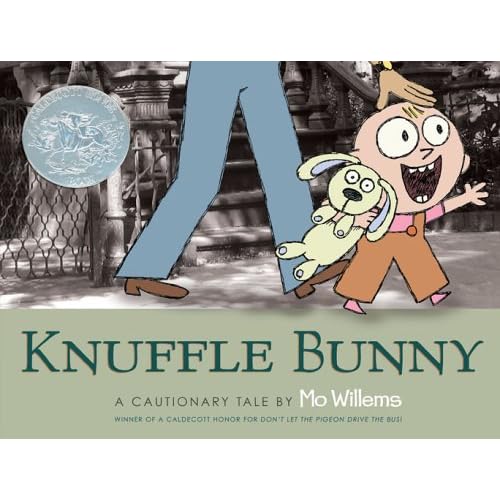
Willems, Mo. 2004. KNUFFLE BUNNY. Hyperion Book. ISBN-10: 0786818700.
PLOT SUMMARY
Trixie happily sets out on an adventure with her daddy to the Laundromat with her prized stuffed bunny. Returning home Trixie uses gibberish to alert her father that her pet is missing. The father has no clue but the mother does and sends the father-daughter team back to the Laundromat where Trixie uses her first words, “Knuffle Bunny!”
CRITICAL ANALYSIS
A storybook for the young, every parent can relate at this level also. A child using babble-jabber nonsense chatter sometimes goes unnoticed. This increases the intensity for the reader because they understand what Trixie wants to say even if the father doesn’t. With simplicity, Willems paints the perfect tale of what might happen when a parent/child cannot communicate.
REVIEW EXCERPTS
Bccb Blue Ribbon Picture Book Awards.
BOOKLIST review(PreS-Gr1). Willems chronicles this domestic drama with pitch-perfect text and illustrations that boldly depart from the spare formula of his previous books. Even children who can already talk a blue streak will come away satisfied that their own strong emotions have been mirrored and legitimized, and readers of all ages will recognize the agonizing frustration of a little girl who knows far more than she can articulate. Jennifer Mattson
Copyright © American Library Association. All rights reserved
SCHOOL LIBRARY JOURNAL review: A seamless and supremely satisfying presentation of art and text.–Martha Topol, Traverse Area District Library, Traverse City, MI
CONNECTIONS
Lost and found. Where do we go when we have lost something? How do we feel when we have found a lost item? Compare and contrast KNUFFLE BUNNY TOO: THE CASE OF MISTAKEN IDENTITIY. With school children let them illustrate their own toy and a place that they would go with a parent. Make puppets using paper bags and dialogue the event. Have them put their "treasure" in the paper bag and hide it in the room. Pair up students. Using gibberish, one student trys to guide the other to the lost item. In a Public library setting, compare other stories of “lost” treasures. For Storytime set up a flannel board story and have children mutter "Trixie" language to verbally involve them in the story. At the end, all children cheer,"Knuffle Bunny!".
BIBLIOGRAPHY
Cummings Pat. 1992. TALKING WITH ARTISTS. New York, NY: Bradbury Press. ISBN 0-02-724245-5
PLOT SUMMARY
Cummings includes conversations with 14 storybook illustrator's including, Jerry Pinkney, Chris Van Allsburg and David Wiesner, author/illustrator of FLOTSAM, reviewed above.Their biographical information is presented first followed by questions from Cummings. Example of questions asked, "Where do the ideas come from? What influences your work? What is a working day like? How did you learn how to draw?" A children's picture and an adult picture is given of each illustrator as well as a piece of their earlier art work when they were a child.
CRITICAL ANALYSIS
I have always been interested in authors and illustrators. CSU Bakersfield holds a Young Author's event yearly inviting students from Kern County to display their published books. On a Saturday, known author's have workshops, autograph books and children can interact and ask author's similar questions that Cummings includes in her books. I have been fortunate to speak with many illustrators. I'm always amazed with the single common thread they share-"If you want it, practice at it and draw, draw, draw". Similarly, suggestions from those that Cummings highlights offered the same encouragement.
REVIEW EXCERPTS
School Library Journal
Grade 3-8-- Conversations with Victoria Chess, Leo and Diane Dillon, Richard Egielski, Lois Ehlert, Lisa Campbell Ernst, Tom Feelings, Steven Kellogg, Jerry Pinkney, Amy Schwartz, Lane Smith, Chris Van Allsburg, and David Wiesner form the content of this book. All say that ``practice, practice, practice'' is the key to success. The illustrators that Cummings interviewed and her own comments are primarily aimed at young people who love to draw. They tell about how they got started, and where they get their ideas and techniques. There are chatty bits of information about the artists themselves, examples of their childhood drawings, and beautifully reproduced samples of current work. The same questions are asked of each contributor, but the answers range from serious commentary to lighthearted humor. The cumulative result is a short course in how to succeed in the book business, and general agreement that illustration is a tremendously satisfying and enjoyable occupation. Young artists will learn a lot; teachers and other children will also love it. Well designed and well conceived, this book will be welcomed in all those classrooms in which children's literature has become central to the curriculum. --Shirley Wilton, Ocean County College, Toms River, NJ
Copyright 1992 Reed Business Information, Inc.
Publishers Weekly
Ages 9-up.In this wide-ranging survey, 14 talented illustrators talk about their childhoods, their work and their daily routines. The broad cross-section includes Caldecott medalists (Chris Van Allsburg, David Wiesner), women (Amy Schwartz, Victoria Chess, Lois Ehlert) and African Americans (Leo Dillon, Jerry Pinkney). Brief autobiographical statements precede interviews that touch on both personal and professional concerns--working conditions, pets, business associates. Each subject is represented by one or two samples of his or her current work and one childhood piece, usually a real charmer.
Copyright 1992 Reed Business Information, Inc.
CONNECTIONS
Create and Illustrator Studies similar to an Author's Studies unit. Have students research information about each illustrator. Post each students self-portrait in the room. Students then can publish their biographical information as highlighted illustrators. Students can write letters to the illustrator coloring their favorite picture from a book. For a month of celebration, create, "We love our Illustrators" display for the school library. Using clay pots, hearts and pipe cleaners, post a picture of the illustrator on the heart, attach it to the pipe cleaner to set in the pot. Include several books that illustrator has completed and place in the same pot.

No comments:
Post a Comment